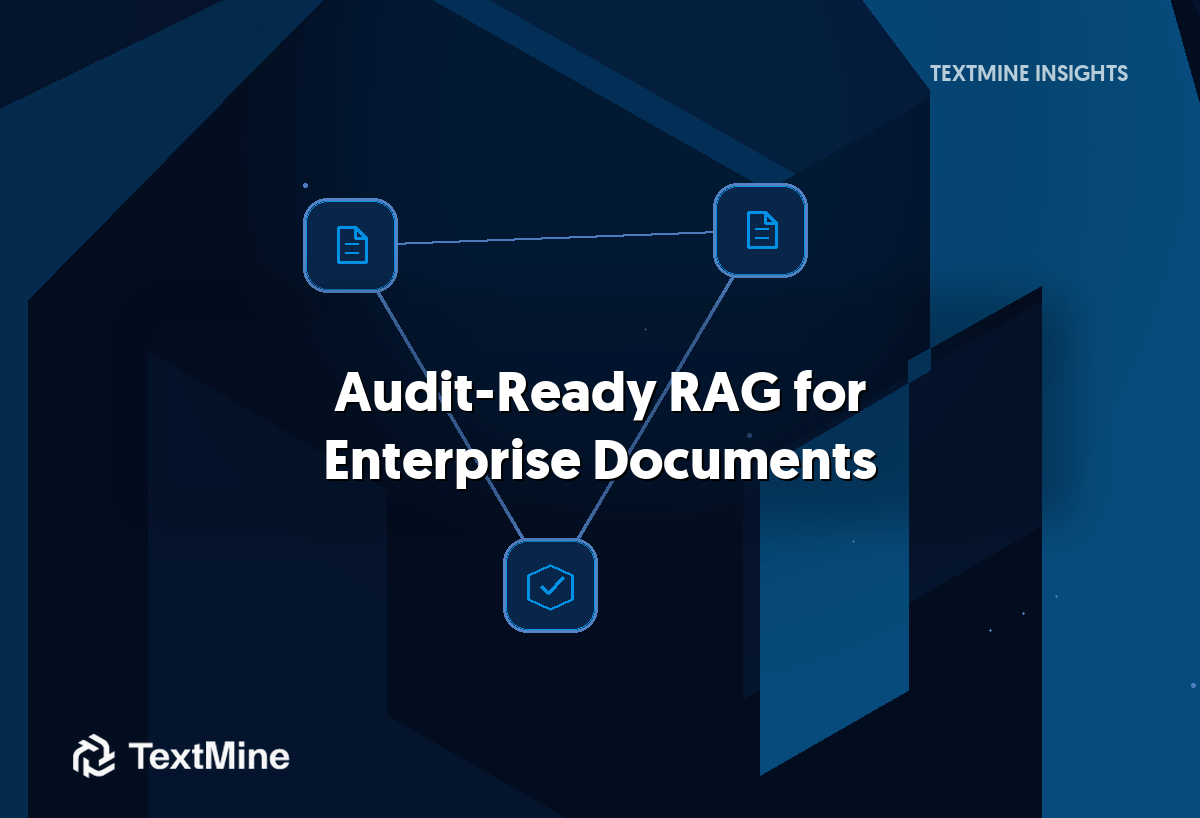
Audit-Ready RAG for Enterprise Documents


Retrieval-augmented generation, or RAG, made it easier to connect LLMs to enterprise documents. Instead of asking a model to answer from memory, the system retrieves relevant content and asks the model to answer with that context. For internal knowledge assistants, this can be valuable. For regulated enterprise documents, it is not enough.
Audit-ready RAG requires more than retrieval. It needs governed context, source-linked evidence, permissions, confidence scores, approval workflows, records, and logs.
Why ordinary RAG is not enough
A standard RAG system may retrieve chunks from a vector database and generate an answer. That answer can still fail regulated requirements if the chunks are stale, permissions are weak, evidence is too broad, confidence is hidden, or the answer cannot be replayed later.
Enterprise document workflows often depend on signed contracts, KYC files, supplier documents, financial reports, and compliance records. In those settings, the system must show which document supported the answer and whether a reviewer approved it.
1. Govern the source corpus
Audit-ready RAG starts before retrieval. Define which documents are allowed into the corpus, which users and agents can access them, and which versions are active. A signed agreement, draft template, expired certificate, and policy exception should not be treated as interchangeable context.
TextMine Security supports the permission and control layer that regulated document workflows need.
2. Extract facts, not just chunks
Chunks are useful for search, but regulated workflows need structured facts. TextMine Vault extracts document facts with source evidence. This gives agents access to governed context rather than raw, unverified text alone.
For example, a contract agent should use the reviewed renewal date, evidence link, confidence score, and reviewer status, not simply the nearest paragraph in a vector index.
3. Keep evidence visible
Every material answer should include source-linked evidence. In TextMine Workbench, users can inspect documents, outputs, and supporting evidence together. That is important when an agent answer needs to be reviewed before it affects a customer, supplier, financial control, or compliance report.
4. Route uncertainty
Audit-ready RAG should know when not to proceed. Low-confidence retrieval, conflicting evidence, missing source documents, and policy exceptions should become workflow events. TextMine Workflows can route those events to the right team for review and approval.
5. Use records as the agent memory layer
A durable record is often a better agent memory layer than an unstructured set of chunks. TextMine Records infer properties from a user-defined schema and data extracted from Vault. This gives agents structured, reviewed, evidence-linked context.
Records also make reporting and downstream system updates easier because they separate trusted values from unreviewed document text.
6. Apply playbooks before action
Before an agent drafts a response, redlines a document, updates a system, or creates a report, it may need to apply policy logic. TextMine Playbooks let teams encode reusable checks for contracts, policies, master templates, and compliance requirements.
7. Log retrieval and activation
An audit-ready system records the user request, retrieved evidence, generated answer, confidence, reviewer decision, and downstream activation. If approved data is sent through an API, MCP workflow, export, or connector, that event should be logged. TextMine Integrations support this activation layer.
Reference architecture
- Documents enter Vault and are parsed into source-linked evidence.
- Facts are extracted with confidence and review state.
- Reviewed facts become Records based on a schema.
- Playbooks apply reusable rules and checks.
- Workflows route exceptions and approvals.
- Agents use governed context and evidence.
- Integrations activate approved outputs downstream.
The standard for enterprise RAG
RAG is useful when it helps a model find relevant context. It becomes enterprise-ready when that context is governed, reviewed, source-linked, and auditable. Without those controls, a RAG system can produce faster uncertainty. With them, it can support regulated operations.
For a related operating model, read The Regulated AI Agent Audit Trail Checklist and The Document Intelligence Maturity Model.

Newsletter

Blog
Read more articles from the TextMine blog