[
Solution
]

How to prepare due diligence document summaries?

Create evidence-backed diligence summaries from contracts, policies, financial reports, supplier packs, and compliance records.
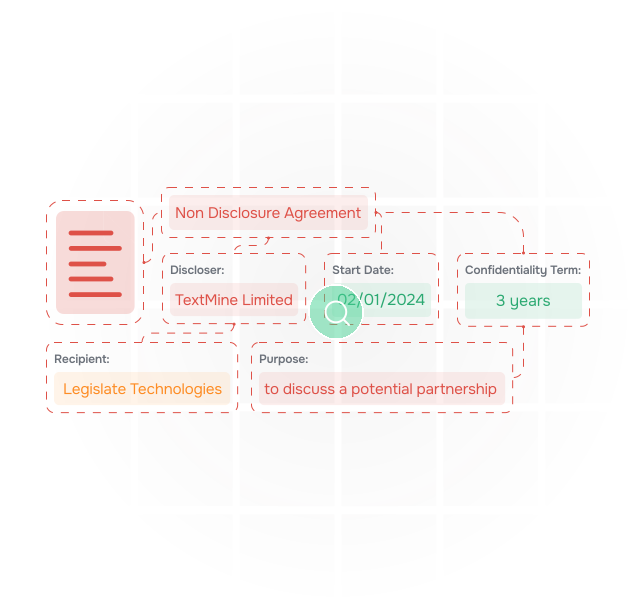
Turn document rooms into structured diligence views

Diligence teams need to understand key contracts, obligations, risks, exceptions, and evidence quickly. TextMine helps reviewers use Workbench to analyse document sets, compare terms, generate tables, and keep source files visible alongside outputs.

Instead of summarising documents in isolation, TextMine links extracted facts to their source evidence in Vault, making findings easier to validate and reuse.

An illustration of data being extracted from documents

Extract what matters for the workstream

For legal diligence, teams can extract change of control clauses, consent rights, termination rights, liability caps, exclusivity, governing law, and data protection terms. For financial, procurement, or compliance diligence, teams can capture supplier risk, revenue commitments, policy exceptions, certifications, open obligations, and document gaps.

an illustration of documents

Route exceptions through review

Workflows can send uncertain or material findings to the right specialist. Reviewers can approve, reject, or amend proposed values, leaving a decision history that supports the final diligence report.

Approved findings can populate Records for searchable summaries and downstream integration.

an illustration of vault extracting data from contracts and answering questions about them

Create client-ready outputs

TextMine helps teams prepare diligence summaries, exception logs, evidence packs, and workstream trackers from the same underlying source-linked dataset. This reduces duplicate effort and strengthens traceability from report to document.

Map the data room
Organise contracts, reports, policies, and supplier evidence by workstream.
Extract core facts
Capture clauses, obligations, dates, counterparties, values, and risk indicators.
Keep source evidence
Link every summary point to document evidence and confidence scores.
Review exceptions
Escalate uncertain or material findings to subject matter experts.
Build records
Store validated findings in structured records for searching and reporting.
Prepare summaries
Generate workstream views, issue logs, and client-ready evidence packs.
Reuse outputs
Carry validated facts into integration, remediation, or post-close workflows.
Map the data room
Organise contracts, reports, policies, and supplier evidence by workstream.
Extract core facts
Capture clauses, obligations, dates, counterparties, values, and risk indicators.
Keep source evidence
Link every summary point to document evidence and confidence scores.
Review exceptions
Escalate uncertain or material findings to subject matter experts.
Build records
Store validated findings in structured records for searching and reporting.
Prepare summaries
Generate workstream views, issue logs, and client-ready evidence packs.
Reuse outputs
Carry validated facts into integration, remediation, or post-close workflows.

Create client-ready outputs

TextMine helps teams prepare diligence summaries, exception logs, evidence packs, and workstream trackers from the same underlying source-linked dataset. This reduces duplicate effort and strengthens traceability from report to document.

Map the data room
Organise contracts, reports, policies, and supplier evidence by workstream.
Extract core facts
Capture clauses, obligations, dates, counterparties, values, and risk indicators.
Keep source evidence
Link every summary point to document evidence and confidence scores.
Review exceptions
Escalate uncertain or material findings to subject matter experts.
Build records
Store validated findings in structured records for searching and reporting.
Prepare summaries
Generate workstream views, issue logs, and client-ready evidence packs.
Reuse outputs
Carry validated facts into integration, remediation, or post-close workflows.
Map the data room
Organise contracts, reports, policies, and supplier evidence by workstream.
Extract core facts
Capture clauses, obligations, dates, counterparties, values, and risk indicators.
Keep source evidence
Link every summary point to document evidence and confidence scores.
Review exceptions
Escalate uncertain or material findings to subject matter experts.
Build records
Store validated findings in structured records for searching and reporting.
Prepare summaries
Generate workstream views, issue logs, and client-ready evidence packs.
Reuse outputs
Carry validated facts into integration, remediation, or post-close workflows.

Watch a video of Vault extract data from documents

How to get started with Vault

To see how Vault performs on your use document data extraction use case, book a demo with a member of our team using the following form.

Thank you! Your submission has been received!
Oops! Something went wrong while submitting the form.