[
Solution
]

How to build a document intelligence operating model?

Design the people, process, governance, and technology model for AI-native document intelligence at enterprise scale.
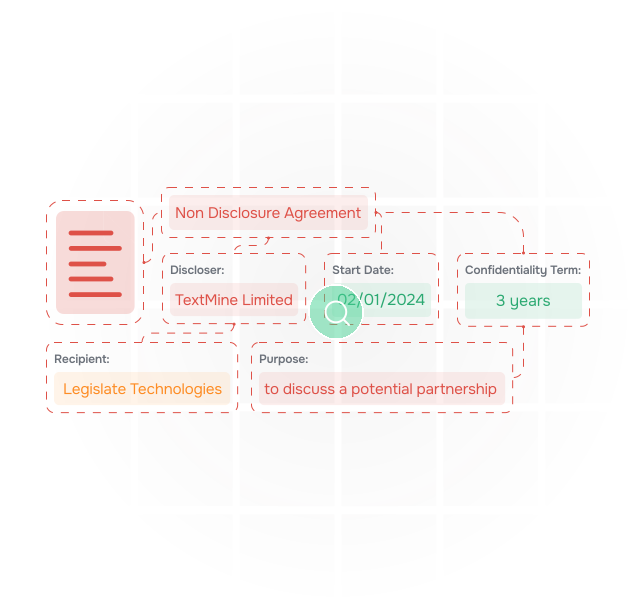
Move beyond point extraction

Document intelligence is not just OCR or a one-off extraction model. Enterprise teams need a governed operating model for ingestion, evidence, review, exception routing, records, integrations, and continuous improvement.

TextMine provides the building blocks: Vault for evidence, Workbench for review sessions, Workflows for orchestration, Records for structured facts, and Playbooks for reusable review logic.

An illustration of data being extracted from documents

Define governance before automation

Successful programmes define what counts as evidence, who can approve extracted values, which confidence thresholds require review, what playbooks apply, and where validated data should go. This helps AI outputs become operationally useful and audit-ready.

an illustration of documents

Design for humans and agents

Human teams need reviewer controls, exception queues, and audit trails. AI agents need governed context, source-linked evidence, confidence scores, and workflow permissions. TextMine gives both a controlled context layer for document-heavy work.

Integrations can connect verified document context to systems, APIs, MCP workflows, and enterprise tools.

an illustration of vault extracting data from contracts and answering questions about them

Scale through repeatable patterns

A strong operating model starts with a few high-value use cases, codifies schemas and playbooks, measures confidence and review effort, then expands across document types and workstreams. TextMine helps teams build that flywheel without losing traceability.

Start with evidence
Define document sources, ownership, retention, and evidence quality standards.
Design schemas
Turn extracted facts into governed records that downstream systems can trust.
Codify playbooks
Capture policies, templates, and review rules as reusable logic.
Orchestrate work
Use workflows for approvals, exceptions, handoffs, and system updates.
Serve agents
Provide AI agents with source-linked context and governed workflow permissions.
Measure confidence
Track extraction confidence, reviewer effort, exceptions, and audit outcomes.
Expand deliberately
Scale from priority use cases into a reusable document intelligence platform.
Start with evidence
Define document sources, ownership, retention, and evidence quality standards.
Design schemas
Turn extracted facts into governed records that downstream systems can trust.
Codify playbooks
Capture policies, templates, and review rules as reusable logic.
Orchestrate work
Use workflows for approvals, exceptions, handoffs, and system updates.
Serve agents
Provide AI agents with source-linked context and governed workflow permissions.
Measure confidence
Track extraction confidence, reviewer effort, exceptions, and audit outcomes.
Expand deliberately
Scale from priority use cases into a reusable document intelligence platform.

Scale through repeatable patterns

A strong operating model starts with a few high-value use cases, codifies schemas and playbooks, measures confidence and review effort, then expands across document types and workstreams. TextMine helps teams build that flywheel without losing traceability.

Start with evidence
Define document sources, ownership, retention, and evidence quality standards.
Design schemas
Turn extracted facts into governed records that downstream systems can trust.
Codify playbooks
Capture policies, templates, and review rules as reusable logic.
Orchestrate work
Use workflows for approvals, exceptions, handoffs, and system updates.
Serve agents
Provide AI agents with source-linked context and governed workflow permissions.
Measure confidence
Track extraction confidence, reviewer effort, exceptions, and audit outcomes.
Expand deliberately
Scale from priority use cases into a reusable document intelligence platform.
Start with evidence
Define document sources, ownership, retention, and evidence quality standards.
Design schemas
Turn extracted facts into governed records that downstream systems can trust.
Codify playbooks
Capture policies, templates, and review rules as reusable logic.
Orchestrate work
Use workflows for approvals, exceptions, handoffs, and system updates.
Serve agents
Provide AI agents with source-linked context and governed workflow permissions.
Measure confidence
Track extraction confidence, reviewer effort, exceptions, and audit outcomes.
Expand deliberately
Scale from priority use cases into a reusable document intelligence platform.

Watch a video of Vault extract data from documents

How to get started with Vault

To see how Vault performs on your use document data extraction use case, book a demo with a member of our team using the following form.

Thank you! Your submission has been received!
Oops! Something went wrong while submitting the form.